December 1, 2008

Gardens and Deer Traffic Patterns

We enjoy walking through our flower garden each morning and evening during the spring, summer and fall. Everyday offers a new experience as we see what's in bloom. We see hummingbirds zooming about, goldfinches feeding on seeds as the honeybees, butterflies and dragonflies flitter around the blooms. In the winter, the time spent in the garden is for maintenance and a check on the status of any possible deer damage.

When we created our flower garden, we had to take into account the traffic pattern of the deer. Had we placed our garden in the middle of a long path, it probably would be more difficult to keep the deer out of the garden. We had just a small section of deer path that we needed to block when creating the garden. In other words, we had to re-route the deer traffic around their little short cut to the meadow.

The deer on our property traverse the same paths at about the same time of day, almost everyday. Most every evening, the deer come out of the woods from the east side of our property and cross diagonally through our front meadow. There's also an opening in the woods on the west side where another group exits in the evening to enter the open meadow. It's easy to find 6-8 deer asleep in our meadow every night when our dog goes out just before bedtime.
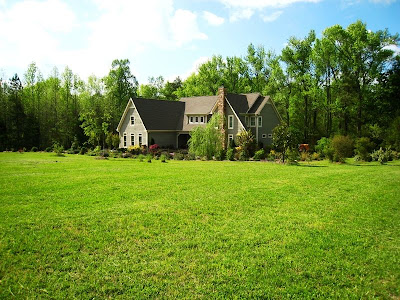


Food supply is often related to rainfall amounts. We've had a lot of rain this year compared to our drought last year, so there has been plenty of food for the deer outside our garden. We have a manmade water feature (stream and waterfall) that runs inside and outside our fence. During the drought, the deer came up to the stream to drink. With all the rain, they aren't coming into the garden for water. If you have a water source in your garden, you may find deer entering your garden in order to drink when water is scarce.

In April 2007, we had almost no blooms on our Lady Banksia rose that is on the outside of our fence. The deer ate the leaves and blooms. This year, April 2008, the deer apparently had plenty of food in the wild, so the Lady Banksia was in full bloom. In other words, if a plant escapes deer damage one year, it might not in subsequent years.
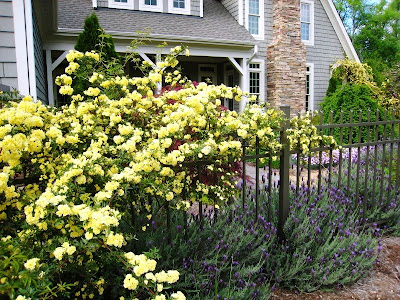


Our fence is 4 feet high which is easy enough for a deer to jump. However, the garden enclosed by the fence is small and includes our house on two sides. If this fence was surrounding a large, open area (like our meadow), the deer would absolutely jump it. I've been told that deer can jump relatively high fences, so 7 feet is what you'll find with a lot of deer fences. I've also been told that they are less likely to jump WIDE hedges where they can't see a place to land safely.
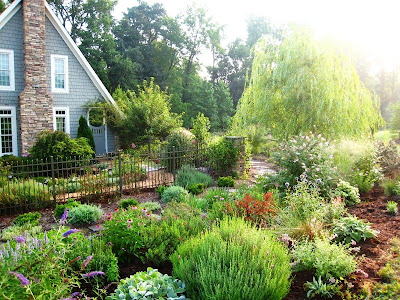


Where our garden meets the meadow, I try to use aromatic plants that aren't appealing to deer.
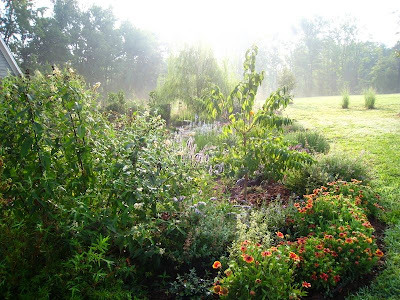


I also group shrubs and small trees at places where deer used to cross the meadow before we built the garden. The shrubs block the previous paths. I created new paths for us. I've been told that if deer cannot see a way out, they won't enter into an area without a visible escape route. Creating a sense of enclosure with dense plantings of shrubs, trees, grasses and perennials breaks up a view of an escape route.

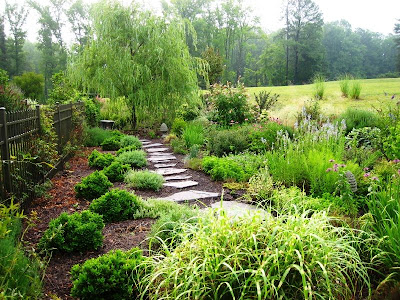
The willow tree is also surrounded by shrubs that are unappealing to deer. This was a place where the deer walked before we planted the shrubs as obstructions to the path and their view. Our garden path makes a left turn at the willow, but that isn't obvious to deer.


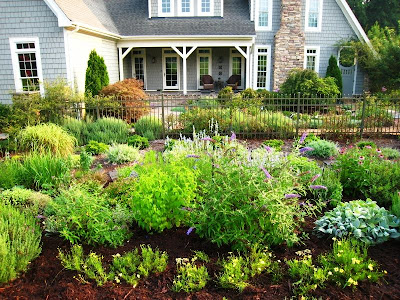
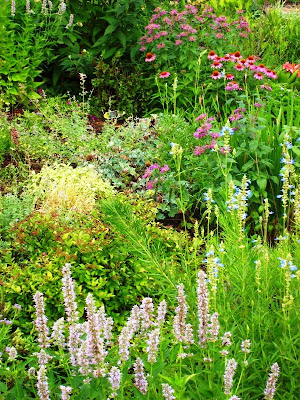
Buddleia, agastache, lavender and nepeta are great aromatic plants to use. I've never had these even sampled by deer (or rabbits). Planting these at the edges of your garden can help deter deer from entering the garden. If you want smaller edging plants in front of the garden, you can use coreopsis (shown here just starting to bloom this side of the buddleia) or lambs ear (shown to the right behind the coreopsis). The garden is planted thickly along the outer edges, providing no clear entry paths from the meadow.


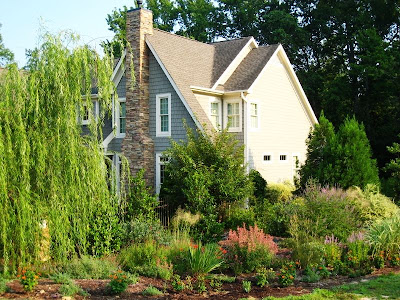
Lavender, agastache and nepeta have aromatic foliage even when not in bloom. Rosemary is also a good choice. Ornamental grasses, bronze fennel, agastache, nepeta, tall verbena, clumping bamboo and tithonia border the outside of the butterfly garden. From this view, it's also difficult for the deer to see an exit route out of the garden and they are less likely to enter.
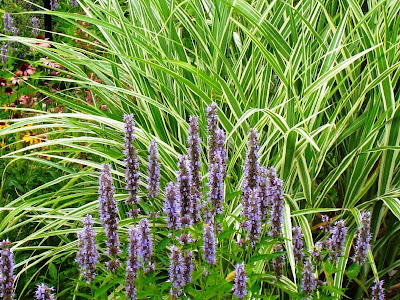
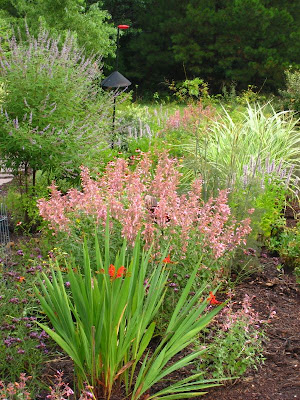


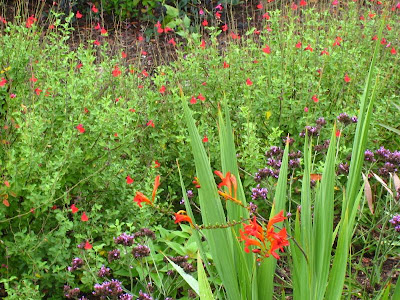
The salvia gregii, tall verbena and crocosmia are of no interest to deer, but are loved by hummingbirds and butterflies.


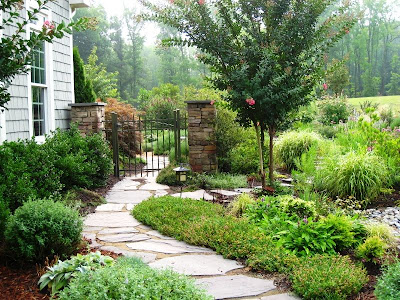
The deer have occasionally strolled up our walkway and down the garden path. Usually this occurs in early spring before the perennials and shrubs are full of foliage.


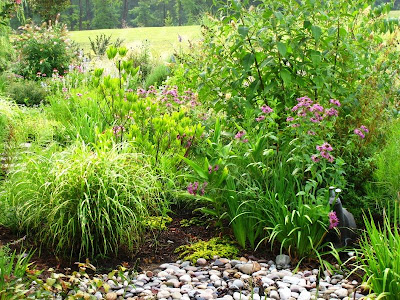
Once the foliage is up high around the dry streambed, the deer stop crossing through this area. The round rocks are also difficult for them to walk across. Since it's too wide to jump, and because they can't see a landing spot, they no longer come through this area.


Some people have reported deer eating coneflowers even though coneflowers appear on most deer resistant plant lists. I've not had a problem, but I plant my coneflowers with companions such as monarda, which is unappealing to deer. A deer won't touch monarda, in my experience.


The deer would have to walk through a lot of unpleasant foliage and blooms to get to the coneflowers. I've been told that when aromatic plants are nose high (around 30 inches), the deer will tend to move on.


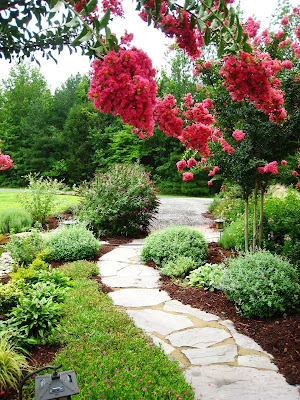
The narrow beds that flank our guest parking area are planted with proven deer resistant plants such as buddleia, lavender, nepeta, hypericum, lambs ear, stachys hummelo, delosperma cooperii, nandina, crape myrtle, cotinus and lantana. The deer will walk through those narrow beds, but there's nothing of interest to eat.


There will always be extreme cases of deer damage, such as deer going up on the porches of homes to eat the plants out of the flower pots. Try to place your garden outside the traffic paths. If you must plant in their paths, do your best to make them go around the area by giving your garden a sense of blocked enclosure. There's a lot of trial-and-error since deer herds have different habits. While waiting for gardens to mature, you will experience more damage with young, tender plants.

We do the best we can! Plant deer resistant plants, obstruct traffic patterns and plant thick, wide groupings. Once fall and winter arrive, there will be more browsing among the evergreens as the deer look for food. When food becomes really scarce, the deer may try plants that they would normally avoid. If there is some damage in winter, but the plants still bounce back to perform beautifully without damage during the spring and summer, then I consider the plant to be deer tolerant.

Story and photos by Freda Cameron

17 comments:

  1. Great post, Cameron. I like the way you illustrate your deer-proofing suggestions with examples and photos from your own lovely garden. I'll be putting your ideas into practice within a year or so.

    ReplyDelete
  2. Me too!! I've got new gardens and and lots of new beds to be planned. I'm going to copy you word for word. Thank you!

    Your home is so interesting. I love the saltbox/cottage/New England flare. I have the same siding but in sage green. I almost went with blue but then I also almost built a farmhouse instead of my craftsman.

    Your gardens are some of the best I've seen. Simply stunning and thanks for sharing so many ideas.

    ReplyDelete
  3. Good morning Cameron ~ Wonderful post and beautiful pictures. It's hard to imagine having to deal with a deer problem, it's not something we have here. Your information will be a great help for those who do though.

    What is that beautiful yellow flowering shrub on your fence?

    Have a lovely day.

    FlowerLady

    ReplyDelete
  4. Hi Cameron, good luck with the new computer, but in the meantime this was a superb post! I will have to come back and reread it and study the photos. Your house and gardens are just a delight, so well thought out too. You have inspired me to try the Lady Banks, I didn't think it would flower here with our late frosts so common. Maybe in a protected area. Your deer handling is a lesson in out thinking their habits, well done!
    Frances

    ReplyDelete
  5. Cameron,

    Your gardens are wonderful, beautiful and inspiring! I, too want to study the photos for ideas for my garden...thank you!

    Having a deer or two visit mine is nothing compared to what you have been dealing with...a full scale assault and ancient deer paths.
    The deer letters have been fun but combating these big destructive creatures is a full time job.

    Take care.

    Gail

    ReplyDelete
  6. This was a post that I wrote back in the summer...since we're having network problems, I couldn't stay connected long enough to write much.

    I just tried to visit other blogs and the network keeps dropping my connection when I try to leave a comment. Photos are almost impossible to see this morning. I now remember what dial-up speed was like!

    Thanks for your patience with my technical difficulties!

    ReplyDelete
  7. I know it gives a sense of detachment when the computer fails. Hope it's up and running soon.

    I'm having trouble this morning, might be my service provider.

    Lovely photos!
    Marnie

    ReplyDelete
  8. I do recognize this post as I think it is the one which helped me to fall in love with your garden. As you are writing of the deer you kind of remind me of Helen at Gardening with Confidence. She collects wildlife with her gardening. What a neat way to look at it. You too with all the deer? Maybe in your case the deer are thinking they are collecting humans in their area?:)

    ReplyDelete
  9. Your garden is beautiful and I must say I appreciate your approach to fitting in with the wildlife, not locking it out, after all, it is such a lovely place, why wouldn't they want to hang out there?

    ReplyDelete
  10. So much of what we're told to plant to avoid deer deals just what they like to eat - rather than considering the animals' habits. Thanks for this. And, you have a lovely home and garden - it must be an absolute joy to wake up to that setting every day.

    ReplyDelete
  11. Your home & gardens are gorgeous Cameron. I really enjoyed strolling through the well thought out borders you have planted so beautifully. Thanks for sharing all the great info about deer traffic patterns. Hope you get your computer problems resolved soon. Take care, Racquel

    ReplyDelete
  12. Cameron - This post is so helpful to me. I will be referring back. We too have deer that sleep on our property and the past couple of years have done more damage to the garden than they did the first several years. Thanks for your solutions and for giving me some ideas.

    ReplyDelete
  13. Cameron, this is my first trip to your blog. What a stunning garden you have! And lots of great advice. Fortunately I don't have to deal with deer but if I could get rid of the squirrels...I'd be a happy gardener.

    Good luck with your new computer. It's amazing how dependent we become on those things!

    ReplyDelete
  14. Glad this deer article is helpful.

    -----
    I'm still having network problems whenever I go to a blog with lots of photos.

    Still haven't recovered by 2008 garden photos. Haven't given up yet!
    --------

    ReplyDelete
  15. I'm so glad you (re?)posted this, Cameron. I've bookmarked it. We have marked out our deer trails, but I'm going to start extending my beds with some of these plants you've listed. Our deer DO like crocosmia, but it grows like a weed here so it's not a disaster when they get into it--still, I don't want it drawing them to other stuff.

    ReplyDelete
  16. Shit... I WANT your hous.. and your garden!
    You can ceep the deers thouh!
    Linda

    ReplyDelete
  17. Cameron: I found your site from a link on the GW Cottage Garden forum - just spent a delightful hour reading about wise ways to deal with deer. Our situations are similar (house and big field) but our deer visit more often in the cooler months.

    I bookmarked your site. So many good ideas and lovely photos!

    Pam

    ReplyDelete

Hello Gardening Friends!

Thank you for visiting my blog and leaving a comment.

I do hope that the stories here are fun, inspiring or informative for you. There are now extra pages (on the left sidebar) that provide shortcuts to topics or more information about popular subjects such as deer and rabbit resistant plants and a summary of posts about Monet's Gardens and Paris.

Browse the TOPICS links, too.

Happy Gardens and Travels!
Cameron
Chapel Hill, NC
Zone 7

PS to Spammers -- I do not care how nice your comment might be, if you posted here just to advertise, your comment will be eliminated.

Who Am I?

My Photo
Chapel Hill, NC, United States
That's pronounced fred-ah, not freed-ah. A freelance garden and travel writer with roots in technology/marketing strategy at SAS Institute Inc. I'm loving my life whether at home, in the garden or traveling. I garden in harmony with bees, butterflies and....deer and rabbits! Zone 7b. My wonderful husband (aka "The Musician") helps with the heavy lifting.

Click Pic for Travel Stories

Click Pic for Travel Stories
Waikiki January 2011