Showing posts with label cottage garden. Show all posts

August 26, 2015

Goodbye, Home and Gardens

Dear readers,

My home and gardens, featured in this blog, are now in the hands of a wonderful family with children and dogs.

The years spent here with my husband were incredible. We loved our neighborhood, our home and the gardens. After "The Musician" passed away from brain cancer, it was time for me to move on. I spent a year here without him and it was bittersweet.

I'm currently renovating a much smaller house, built in 1939.  It's a project! There are still months to go to completion and I'll have new garden opportunities on the established half acre lot.

Thank you for reading my blog. I'll keep it alive for reference purposes on the many plants that I grew over the years. Thank you, garden bloggers. I've met many of you in person and consider many others as friends as we still engage in other social media.

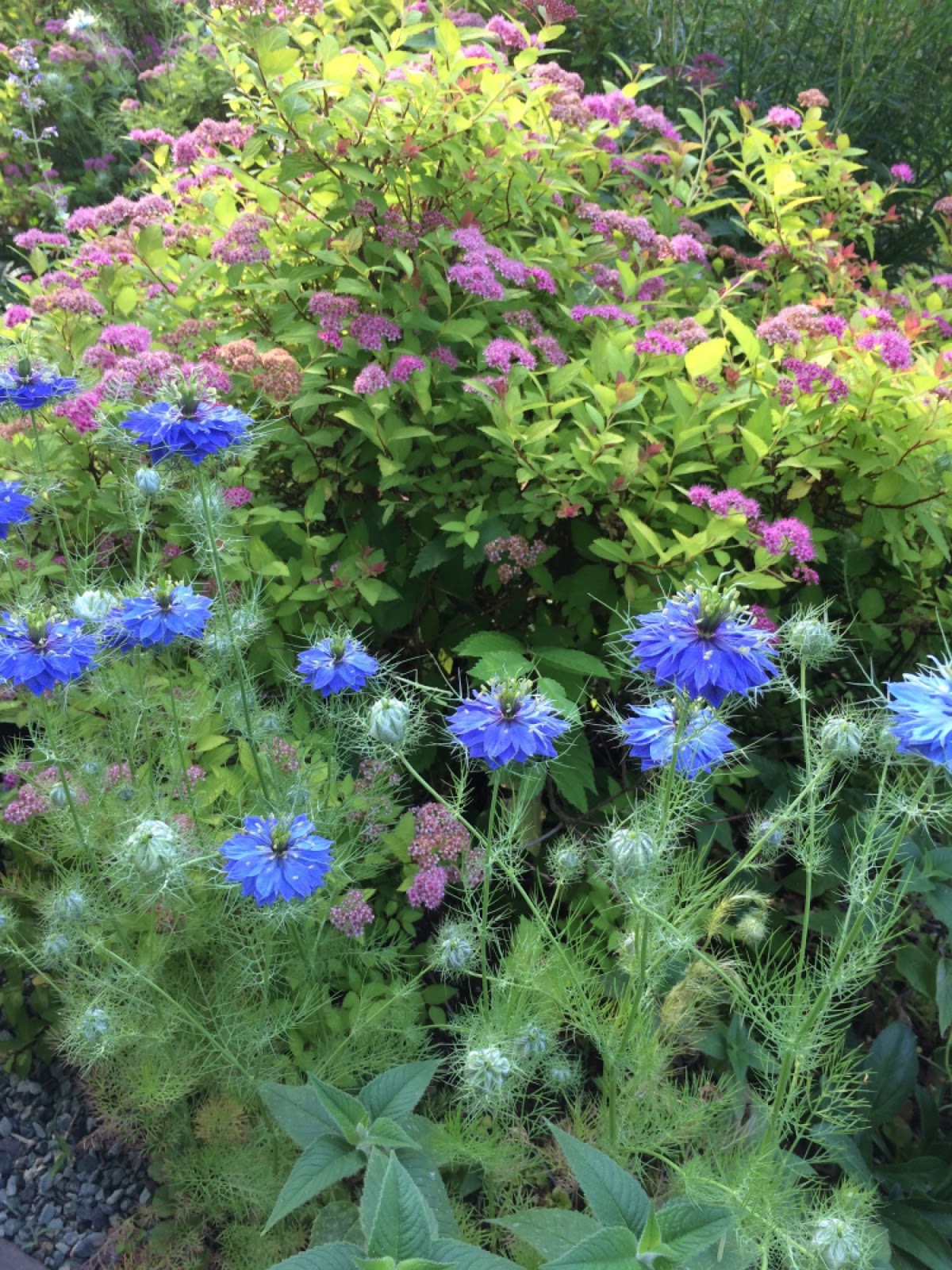
Here are a few last photos of the garden in 2015.

The cottage garden


Nigella, a favorite grown from seed

The deer resistant garden


Words and photos by Freda Cameron, Defining Your Home, Garden and Travel. Deer and rabbit resistance varies based upon the animal population and availability of food. All company or product or patented names mentioned are registered trademarks, copyrights, or patents owned by those respective companies or persons.

September 17, 2013

Pics from Paris: Seeing Red at Luxembourg Gardens

Luxembourg Gardens Paris by definingyourhome
Luxembourg Gardens, Paris.  15 Sept 2013
The fashionable color combo around the Senate building at Luxembourg Gardens is red and purple. This is another favorite garden in Paris where I've never seen the same combinations repeated on my many visits over the years.

Luxembourg Gardens Paris by definingyourhome
Familiar flowers combined for a unique design.
Castor bean, dahlias, petunias and geraniums dominate.
Luxembourg Gardens Paris by definingyourhome

Luxembourg Gardens Paris - Defining Your Home Garden and Travel
Panoramic view of public section of the gardens.
Pink (begonias and anemones) and blue plumbago towers (corners) are introduced.
Luxembourg Gardens Paris - Defining Your Home Garden and Travel
I like the use of purple fountain grass and purple spires of salvia.
Luxembourg Gardens Paris by Defining Your Home Garden and Travel
Add caption
Luxembourg Gardens Paris by Defining Your Home Garden and Travel
I'm inspired by the spires of salvia. Love this look.
Luxembourg Gardens Paris by Defining Your Home Garden and Travel
On a smaller scale, this would look great in a cottage garden.
The color coordination of my scarf with
the garden was purely coincidental.

Words and photos by Freda Cameron, Defining Your Home, Garden and Travel.  All company or product or patented names mentioned are registered trademarks, copyrights, or patents owned by those respective companies or persons.

July 5, 2013

My Favorite Phlox

phlox David by Defining Your Home Garden and Travel
White Phlox paniculata 'David' with
'White Swan' and 'Prairie Splendor' coneflowers. July 2013
Tall, sturdy and fragrant. I love phlox 'David' for so many reasons. While other varieties have cross-pollinated into different colors, David has remained pure white. 

The show is big this year as I cut back the Knock Out® roses to give this mass of David more space. No regrets—the roses bloomed beautifully and will repeat. However, the crepe myrtles along the outside of the cottage garden fence will soon shade this area enough for me to replace the roses with hydrangeas. I hope David will continue to flourish here in part shade.

Difficult to see in the photo: Spiky, deep pink persicaria amplexicaulis 'Firetail' is beginning to bloom behind David to repeat the purple coneflower color. I love this persicaria and look forward to masses of spikes as the perennial gets established in this new spot.

(Note: After two years of growing the persicaria in the deer resistant garden, I removed it because it's not resistant at all. The deer love it and reach through the fence to pick the blooms.)

There are also new clumps of white liatris 'Alba' in the cottage garden border. Because we sit on the front porch in the evenings, I'm using the white to light up the garden along the fence.

phlox David by Defining Your Home Garden and Travel
Another view of same phlox in the cottage garden. July 2013
phlox David by Defining Your Home Garden and Travel
Another group:
Recent divisions of phlox 'David' are underplanted
with geranium 'Rosanne' and daylily 'Joan Senior' for now.
I've repeated divisions of David along the cottage garden fence. One group is underplanted with geranium 'Rosanne' and 'Joan Senior' daylily. I want to move that daylily to my pale yellow garden section for next year and replace this one with a daylily that will echo the color of the geranium.

Another group is planted with salvia guaranitica 'Black & Blue'. I don't have photos right now because those clusters of phlox aren't yet in full bloom. But I love the cobalt blue salvia with white phlox. The hummingbirds approve.

In a larger cottage garden border, I'm still growing David with monarda 'Raspberry Wine' and oriental lily 'Starfighter' for a favorite combination (click the link to view the story and see the photos).

Grow phlox paniculata 'David' in full sun in zones 4-9, but part shade is working well here in my south-facing southern garden. This perennial is topping out at about forty inches with rich soil and ample moisture. It's so easy to divide in autumn or spring.

What's your favorite phlox?

Words and photos by Freda Cameron, Defining Your Home, Garden and Travel. Deer and rabbit resistance varies based upon the animal population and availability of food. All company or product or patented names mentioned are registered trademarks, copyrights, or patents owned by those respective companies or persons.

June 16, 2013

A Favorite Combination: Coneflower, Salvia and Verbena

coneflower echinacea Pow Wow Wild Berry  by Defining Your Home Garden and Travel
Echinacea 'PowWow Wild Berry'. 16 June 2013

The cool temperatures and ample rainfall boosted the coneflower blooms to the best I've seen in years. After losing many coneflowers, including the variety featured to aster yellows disease in 2012, I'm happy to see healthy plants.

One of the short varieties, echinacea 'PowWow Wild Berry' is blooming beautifully beside salvia farinacea 'Victoria Blue' in the cottage garden. I love this combination when the blooms synchronize and peak in unison. The frilly, ground-covering lavender blooms are verbena 'Imagination'.

These three plants bloom over a longtime, front and center, in the cottage garden. The echinacea reblooms through the summer (supposedly without deadheading, but I deadhead to speed up the repeat). It can be grown from seeds, though I purchased my plants.

The salvia is another repeat bloomer, with the best show in early summer and again in the fall. Again, I purchased my plants, but you can grow this one from seeds, too.

The combination fits well into small spaces, but the verbena is a prolific self-sower, so watch if it spreads too far and wide. I trim it back to keep it shaped for the space and pull unwanted seedlings. The verbena blooms non-stop until frost.

Although these three plants are great together, they seem to enhance any location in the garden. I use the verbena as an edger or filler in multiple locations. The salvia is a go-to plant to use with dianthus, zinnias, black-eyed susan and daisies.

This trio is growing behind the protection of the cottage garden fence, but I grow all three in the deer resistant garden. Bunnies are more interested in the coneflowers than the deer, but in some areas, you may need to use repellents. Neither bunnies nor deer eat the verbena and I've had no issues with the salvia.

Echinacea purpurea 'PowWow Wild Berry'
perennial zones 3-8
full sun-part sun

Salvia farinacea 'Victoria Blue'
perennial zones 7b-11
full sun

Verbena tenuisecta 'Imagination'
self-sowing annual (has wintered over, zone 7b)
full sun


coneflower echinacea Pow Wow Wild Berry  by Defining Your Home Garden and Travel
Another view of 'Pow Wow Wild Berry' (one plant). June 2013

cottage garden  by Defining Your Home Garden and Travel
Another view of same Salvia 'Victoria' with dianthus
and daylily. June 2013

cottage garden  by Defining Your Home Garden and Travel
Verbena tenuisecta 'Imagination' (different location).  May 2013

Words and photos by Freda Cameron, Defining Your Home, Garden and Travel. Deer and rabbit resistance varies based upon the animal population and availability of food. All company or product or patented names mentioned are registered trademarks, copyrights, or patents owned by those respective companies or persons.

May 2, 2013

The Bright Side of Gloomy Garden Days: Better Color Photos

cottage garden  by Defining Your Home Garden and Travel
Container hosta nestled between nepeta and Japanese painted ferns,
growing beneath a tree-form Encore® Azalea. May 2013
Gloomy. Misty. Chilly. Where do I live? Not Seattle. North Carolina is having a cool spring. To find a bright side to this weather, I walked in the garden with the camera.

Colors show true in photos when the skies are overcast. On a typical, bright sunny morning in my south-facing garden, it is difficult to catch the true bloom colors as the rays of the sun cast a yellow-orange glow. I compared the two conditions in this photo post in 2009.

So, I'll stop complaining about wearing a raincoat outside and running the heat inside and share today's garden highlights in the lowlight.

Perennial blue flax, grown from seeds originally sown in 2009, continues to return or self-sow. Flax is a favorite and I have two varieties that, when transplanted early in spring, are welcome fillers in bare spots. Otherwise, I let it go where it sows as the slender foliage takes up little space. Deer and rabbit resistant. For more photos of this companion, click here for 2011 and here for 2010.

cottage garden  by Defining Your Home Garden and Travel
Two views of perennial blue flax. May 2013

cottage garden  by Defining Your Home Garden and Travel
Spires of salvia nemorosa Bordeaux™ 'Steel Blue'. May 2013
cottage garden  by Defining Your Home Garden and Travel
Salvia 'May Night'. May 2013
Salvias rule. My best nemorosa varieties include Bordeaux™ 'Steel Blue', 'Caradonna' (not yet in bloom) and 'May Night'.  Of the three, I can't choose a favorite, but 'Steel Blue' and 'Caradonna' are more unique than the popular 'May Night'.

The shades of red in my salvia greggii have a more accurate representation on cloudy days. I'm a fan of this drought-tolerant perennial that blooms heavily in spring and fall, and is loved by hummingbirds. Below are two of my favorites, but take a look at this post on April 26, 2012 and you can see the difference the cooler weather has made. Today's blooms are nowhere near the display of last year. Deer and rabbit resistant.

cottage garden  by Defining Your Home Garden and Travel
Salvia greggii 'Diane' is a lovely purple-red. May 2013.
I failed to capture the quick hummingbird feeding on
salvia greggii 'Navajo Bright Red'. May 2013.
Verbena 'Imagination' dangles over the cottage garden stream.
May 2013.
I'll wrap this up with dainty bloom clusters of verbena 'Imagination' that was sown from seeds and the native amsonia hubrichtii, two of my favorite frilly bloomers. Both self-sow freely and it is easier to keep the amsonia under control than it is the ground sprawling verbena. Deer and rabbit resistant.

I've been using my iPhone for many photos lately, but for today's post, all photos were taken with my Samsung HZ30W, purchased in 2011.

Until there are more blooms in my garden...enjoy yours.

Amsonia hubrichtii at the edge of the gravel garden. May 2013.

Words and photos by Freda Cameron, Defining Your Home, Garden and Travel. Deer and rabbit resistance varies based upon the animal population and availability of food. All company or product or patented names mentioned are registered trademarks, copyrights, or patents owned by those respective companies or persons.

April 28, 2013

Weeded, Mulched and Waiting for Blooms in the Cottage Garden

cottage garden  by Defining Your Home Garden and Travel
The cottage garden, bare compared to previous springs,
 is ready and waiting for blooms. April 27, 2013.
Any complaints about the weather where you garden?

The cool temperatures, while delaying the blooms, provided the perfect weather for preparing the garden. I don't feel as rushed this year and gardening has been more enjoyable. It isn't ninety degrees already. Sixty and seventy degree weather could be worse as other parts of the country have been flooded and experienced late snows.

Looking at photos from 2006-2012, peak spring bloom in the cottage garden happened in the first week of April.  Still waiting for blooms, but the plant foliage looks healthier and happier than ever.

The centaura varieties (in the photo below) were tiny new plants in 2012, and now, they're starting out huge! In a future post, I'll tell you more about centaurea gymnocarpa "Velvet Centaurea" as it blooms. It's one of my new favorites and hope it meets my expectations.

cottage garden  by Defining Your Home Garden and Travel
Silver lace foliage of centaurea gymnocarpa in back.
Green foliage of centaurea montana 'Amethyst in Snow' in front.
cottage garden  by Defining Your Home Garden and Travel
The rose bed along the fence received a make-over.
In February, the Knock-Out® Roses (dark foliage above) were cut back by two-thirds. I edited this rose bed, adding divisions of other perennials and tucking in a few annuals around the greyhound statue. I'm most excited about this area in the cottage garden to see the results of my rearrangement, having incorporated more white blooms (phlox, liatris, cosmos) for late evening enjoyment. Another future topic.

Few Dutch Iris remain after vole damage from previous winters.

The voles took a bite out of the cottage garden in the winter of 2011-2012. We added metal edging and used more gravel in areas surrounding the cottage garden. Doing so thwarted the varmints this winter, so I'm encouraged. I've made my wish list of bulbs and seeds to plant this fall for spring 2014.

While the blooms are sparse right now and we have another week of cool temperatures in the forecast, I'm envisioning a peak bloom like I've never seen before—when spring blooms merge with early summer blooms.

Perennial blue flax is being encroached upon by pink phlox subulata.
Encore® Azaleas typically bloom around April 5, but waited until April 27.
P.S. There's a new dog in the garden. Meet Brie, our six-month old miniature poodle puppy. She's a sweetheart.

Puppy look one day.
After her first professional spa day.
No longer a little ragamuffin.

Words and photos by Freda Cameron, Defining Your Home, Garden and Travel. Deer and rabbit resistance varies based upon the animal population and availability of food. All company or product or patented names mentioned are registered trademarks, copyrights, or patents owned by those respective companies or persons.

December 5, 2012

Favorite Flower Combinations in 2012 - Part Two

cottage garden  by Defining Your Home Garden and Travel
Rudbeckia (yellow blooms), loropetalum (shrub)
and monarda (raspberry blooms).
The burgundy foliage of loropetalum chinense rubrum anchors this color scheme and has been paired with monarda 'Raspberry Wine' for years. For 2012, I added a mass of rudbeckia (grown from seed) as the deep brown eye of the susans picks up the chocolate tones in the loropetalum. I was hesitant to add the gold-yellow color to the cottage garden, but the brightness of the blooms do brighten the heavy shades of burgundy.

All plants are growing in full sun, south-facing in zone 7b in the fenced cottage garden. When hungry, deer will nibble the loropetalum, especially in winter since it is an evergreen shrub.  The rudbeckia are grown easily from seed, so I don't worry so much about the occasional deer nibbling and grow the susans outside the fence, too. Rabbits may also nibble rudbeckia foliage and blooms.

Monarda 'Raspberry Wine' is a great bee balm and you can click here to see what's growing on the other side of this combo. Yes, it will spread easily, but bee balm isn't difficult to remove if you have too much. This variety is suitable for zones 4-9 and has been good in drought without a mildew issue.


cottage garden  by Defining Your Home Garden and Travel
Another view


Words and photos by Freda Cameron, Defining Your Home, Garden and Travel. Deer and rabbit resistance varies based upon the animal population and availability of food. All company or product or patented names mentioned are registered trademarks, copyrights, or patents owned by those respective companies or persons.

September 30, 2012

Favorite Flower Combinations in 2012 - Part One

Cottage garden. May 1, 2012
Shades of purple and pink tumble and intertwine along one of the paths in the cottage garden. In the correct zones, these perennials are reliably drought tolerant and will provide a long bloom season.

To recreate this combination in a hot, full sun location, use the following plants (Click the links for each plant to read previous in-depth articles):

Perennial heliotrope (heliotropium amplexicaule). Zones 7-11, deer resistant
Wine cups (callirhoe involucrata). Zones 3-9, NOT deer or rabbit resistant
Salvia greggii 'Diane'. Zones 7-9, deer resistant
Salvia nemorosa Bordeaux 'Steel Blue'. Zones 4-8, deer resistant

View Part Two.


Words and photos by Freda Cameron, Defining Your Home, Garden and Travel. Deer and rabbit resistance varies based upon the animal population and availability of food. All company or product or patented names mentioned are registered trademarks, copyrights, or patents owned by those respective companies or persons.

July 20, 2012

Coreopsis (and Company) in the Cottage Garden

Coreopsis 'Star Cluster' in bloom with companions
Eucomis 'Sparkling Burgundy' (foliage left)
 echinacea (multiple varieties back)
 and purple phlox 'Nicky'.
Three plants of Coreopsis 'Star Cluster' PPAF were added to my cottage garden in 2011. I was so impressed by the performance and beauty of this coreopsis, that I purchased five more plants this spring.

This 2010 introduction in the Big Bang ™ series is from Darrell Probst. For several years, I've happily grown his taller Coreopsis 'Red Shift' in the deer resistant meadow garden. 'Star Cluster' is shorter at 18-14 inches high and wide, making it more suitable for the scale of my cottage garden.

A few months ago, Darrell sent me an email about my experience with the color of the 'Star Cluster' here in the southeast. As expected, the coreopsis begins to bloom a creamy white and the deep purple eye spreads from the center during the cooler weather in the fall.

Deadheading isn't required for this long-blooming perennial, but I do a bit of shaping of the plants when I'm tidying up the garden.

Suitable for zones 5-9, this full sun plant is a great performer, being reliably rabbit and deer resistant. In the cottage garden, the coreopsis grows in rich soil, but is suitable for average soil such as in the drier meadow garden.

Given the long bloom season, I've surrounded the coreopsis with a number of blooming perennials to complement the plant. Those include garden phlox, coneflowers (multiple varieties), daylily 'Joan Senior' (similar bloom color) and salvia guaranitica 'Black & Blue'.

The dark foliage of eucomis 'Sparkling Burgundy' is especially pleasing to me in combination with 'Star Cluster' blooms. This is the first year for eucomis in the cottage garden, so the blooms are just beginning to form. I anticipate that this duo will be one of my favorite combinations!


Words and photos by Freda Cameron, Defining Your Home, Garden and Travel. Deer and rabbit resistance varies based upon the animal population and availability of food. All company or product or patented names mentioned are registered trademarks, copyrights, or patents owned by those respective companies or persons.

June 30, 2012

Refreshing 'Little Lime' Hydrangea

First bloom of 'Little Lime' Hydrangea. June 28, 2012.
What's the most refreshing bloom color on a 100°+ summer day?  My vote goes to the huge, cool snowballs of 'Little Lime'™ hardy hydrangea from Proven Winners®. 

I know! I know! I'm obsessed with refreshing lime and refreshed light green garden benches to cool down my garden!

After seven years of waiting for shade, I finally have a spot for hydrangea, my favorite summer shrub. At previous homes, I grew so many different varieties, but here in my small cottage garden, the small sliver of all-day shade requires a small shrub. In late May, while on a plant shopping trip to Big Bloomers in Sanford, I asked for 'Little Lime' and they had it in stock! Fortunately, with deep watering, it is well-established in time for this run of triple-digit heat.

'Little Lime' is not that tiny—the height and spread will be between 36-60 inches. I'm totally okay with a bit of overlap onto my path and through the fence, but since it blooms on new wood, size won't be much of an issue. With a zone rating of 3a-9b, I'm also encouraged by the hardiness since I'm in 7b. My theory is that if a plant can handle at least two zones colder and two zones hotter, then it should be a stellar performer.

In my excitement to show you this hydrangea, I took photos before the shrub is in full bloom. None of the companions are in bloom, but my color scheme is simple—use lime-to-white with blue-lavender-purple flowers.

There's an existing clematis 'Jackmanii' on the right that blooms purple in late spring.

To the left (and not shown because the plants are newly planted and not blooming), I'm using white phlox 'David', white milkweed (asclepias incarnata 'Ice Ballet') to provide flower form similar to the hydrangea.  The blue mist flowers of hardy ageratum 'Wayside' were transplanted to fill in around the perennials to provide some separation between the lime and white blooms.

In front of the tall phlox and milkweed, I've added purple/blue hardy geranium 'Rozanne' because this combination, with white phlox, is a favorite in another bed in the cottage garden. 'Rozanne' mounds and scrambles as well as provides another leaf shape.

For a bit of foliage filler in front of the blues, the green/white leaves of annual 'polka dot' plant echoe the white theme.

On the outside of the fence, the row of lavender blooming crepe myrtles (probably 'Muskogee') are assisting the weeping willow to provide shade.

What's your favorite color of cool?


Blue-purple geranium 'Rozanne' scrambles up the tall, white Phlox 'David'
in another location in my cottage garden. June 28, 2012.
Hardy ageratum (shown from another garden section)
is to provide filler between the white and blooms of phlox, milkweed
and the lime hydrangea.

A row of three lavender crepe myrtles outside the cottage garden
provide shade for the new hydrangea
(inside the fence and away from the deer). June 28, 2012

Words and photos by Freda Cameron, Defining Your Home, Garden and Travel. All company or product or patented names mentioned are registered trademarks, copyrights, or patents owned by those respective companies or persons.

June 29, 2012

Garden Benches Refreshed

Many, many years ago at a property that I no longer own, a neighboring farmer teased me when I was painting my old, weathered barn. He said "A little bit of powder, a little bit of paint will make it look like what it ain't."

It was true that the old barn had warped boards and a rusty metal roof. It needed more help than a coat of paint. Fortunately, my metal garden benches were showing only a bit of rust and faded color—easily remedied by a good scrubbing and a coat of fresh paint. After seven years in the garden, I was ready to use some color.

I bought the spray paint, Valspar® Satin Leafy Rise, as my color of choice. It's a pale green that looks so much cooler than the dark bronze of the cottage garden bench or the black of the gravel garden bench. I also painted a rusty metal plant stand and a pot.

I'll have a solid color deck stain mixed to match the benches to use on our two wooden bridges. One wooden bridge is in the cottage garden over the flowing stream and the other is over the dry stream in the gravel garden.

For the last few days and the last cool temperatures of June, we've enjoyed sitting on both benches. With temperatures soaring to above 105°F today and tomorrow, we won't be sitting outside on the benches again soon!

Cottage garden bench was painted from bronze to green.
The willow tree has matured over seven years. I removed a jasmine
from the stone fence column as well as two large shrubs on either side of the bench.
I've been replanting the areas with perennials and will finish the make-over in the fall.


The gravel garden bench was black (and rusty) before being painted.
I'm still using containers that I had on hand, but continue to look
for upgrades that I like (or paint all containers to match).
The lavender plants in the urns have just been trimmed and a
few annuals were added around the juniper.


Words and photos by Freda Cameron, Defining Your Home, Garden and Travel. All company or product or patented names mentioned are registered trademarks, copyrights, or patents owned by those respective companies or persons.

June 18, 2012

Garden View from Street and Above

Left of house is west and driveway with entry gravel garden.
 Right is east with the red/white and orange/yellow flowers.
Front is south-facing with 2 acres of open meadow grass.
There is no garden in the back (north) as our woods (2.5 acres) come up to the back deck.


Paved driveway (west) ends in the gravel entry garden.


The gravel entry garden is the first thing a visitor sees when arriving. There is sufficient space for a car to park in front of the bench. In a few years, the dwarf Burford 'nana' hollies will create a hedge to separate the gravel garden from our concrete parking area for our garage. A large oakleaf holly and a crepe myrtle flank the bench area. A row of rosemary lines the opposite side of the gravel parking space. 


The gravel entry garden along the front of the garage wall.
From the gravel parking area, a hedge of hollies line the garage wall. The arched bridge crosses the dry stream to the meadow grass. A crepe myrtle on the lower right is underplanted with dusty miller and sedum. A ground-level birdbath is not shown from this window shot. Crepe myrtle, nepeta, buddleia, monarda, amsonia and salvia greggii are planted in the gravel garden.


The flagstone path splits.
One goes into the cottage garden and to the front porch.
The other goes to the right along the front
deer resistant meadow garden.
Perennial scutellaria suffrutescens 'Texas Rose' and thyme are planted as ground cover at the base of the right stone column at the garden gate. Just inside the gate, along the fence, I'm redoing this narrow strip. My project is on hold due to ground bee nests! I pulled out nigella and was fortunate not to be stung. On the outside front of the fence, three more crepe myrtles and carissa hollies are growing in the gravel and that is why the flagstone is pushed to the right in the deer resistant garden. We are leaving space for the trees and shrubs to mature.


Larger round decorative rock is used on the horseshoe-shaped
cottage garden path (only half visible here).


In the cottage garden, the flagstone goes to the porch while rounded, small rock is used on the loop around the front and back of the running stream. 


I recently planted a new narrow strip (right of bench) of phlox 'David', asclepias incarnata 'Ice Ballet', hydrangea 'Little Lime', geranium 'Rosanne', sweet alyssum, hardy ageratum and annual polka-dot plant. I removed two shrub roses that were no longer receiving sufficient sun as the trees are maturing. 


I also removed a jasmine from the stone column behind the bench. It had begun to be nearly uncontrollable as the willow limbs provided a place to climb. I have plans to extend the narrow strip around the corner behind the bench to fill space where the jasmine was removed.


A few days ago, I spray painted the rusting bronze metal bench and a small iron table to a light green. There are false agave in the matching concrete urns (stained light green). I'd like to stain the bridge, but I'm having trouble finding a deck stain in light green and hesitate to use paint since we walk on this bridge so many times each day.


I'm redoing the corner, having painted the bench and changed out
the plantings on either side while removing a jasmine from behind the bench.


Cross the cottage garden bridge and open the gable gate
to the secret patio waterfall garden. A bistro table and chairs
aren't showing up in the photos, but this is the perfect spot for
morning coffee or evening wine.


The waterfall patio garden is now totally secluded since we built it in 2005. With all of my sunny gardens of blooms, the focus of this garden is foliage. There are three containers of heuchera, heucherella and tiarella and a planter of trailing tiarella and a pulmonaria. A hanging basket includes another heuchera and purple heart. Gold creeping jenny softens the rocks along the stream bank. 


Variegated carex are still going on one side of the waterfall, while those planted on the other side are getting shaded out. This will require a re-do in the future. Calla lilies grow in the waterfall. The large green trees are cryptomeria and there are gold mops on the right side across the stream.

Not possible to photo from above is yet another patio, sunken lower to the left that has a large teak dining table. Just as well not to photo as we're redoing the gardens there as the curly willow and sweet bay magnolia are now mature. In other words, I'm not showing you the weeds! With a theme of fragrance from white blooms—other plants surrounding that patio include butterfly ginger, jasmine, gardenia and osmanthus fragrans.

The east deer resistant garden (couldn't be photographed from house) has been undergoing renovation this year with wider paths and a gravel section. Sun-loving plants have been moved from beneath the willow to open areas. There are two color scheme gardens here—a red/white garden and a yellow/orange garden. There is much yet to do beneath the willow and back to the dining patio. Those projects will be tackled in the fall or in spring 2013.

East side deer resistant garden of red/white and yellow/orange...and a lot of green.


Words and photos by Freda Cameron, Defining Your Home, Garden and Travel. Deer and rabbit resistance varies based upon the animal population and availability of food. All company or product or patented names mentioned are registered trademarks, copyrights, or patents owned by those respective companies or persons.
Freelance travel writer. My current fiction writing projects include a completed manuscript and several works in progress.

By the way, my name is pronounced fred-ah, not freed-ah. Thank you.

Subscribe Now:

Followers

Click Pic for Travel Stories

Click Pic for Travel Stories
Paris, France; September 2013

The Musician. My late husband

The Musician. My late husband
Paris 2011